Collection episode 01 · 2:12 · English
Peptides in 2TM · BPC-157
Repair and digestive research
Explore experimental BPC-157 research in tissue recovery and the digestive tract, keeping animal findings, human reports, and their limitations distinct.
English narration with optional English captions. Caption timing is recognition-assisted. Translated subtitles are not yet available for this episode.
Published . Evidence checked: October 15, 2026.
Behind the film: references & context
Identity and scope
BPC-157 is an experimental peptide comprising 15 amino acids. Laboratory and animal results can generate hypotheses; they do not establish that a person recovers faster. The film separates tissue-recovery questions from digestive-disease research. [5]
The human knee-pain report
Lee and Padgett identified 17 patients and contacted 16. Twelve respondents had received BPC-157 alone; 11 reported significant pain improvement. Four others received it with thymosin beta-4. This uncontrolled retrospective report does not establish efficacy or structural repair. “Significant” follows the authors’ description, not an asserted statistical significance test. [1]
Digestive research: animal findings
Rat experiments reported reduced experimentally induced gastric ulcers and improved healing in fistula models. These are encouraging preclinical findings, not demonstrations of reliable treatment success in people. The anatomical artwork does not depict an observed BPC-157 outcome. [2][3]
Digestive research: the human evidence
A 2005 ulcerative-colitis trial, reported in a conference abstract, randomized 53 participants. Disease-activity scores improved in both groups, but the between-group estimate was too uncertain to establish benefit over placebo. FDA judged the available data inadequate to establish efficacy and safety for that use. The abstract is discussed through FDA’s evaluation; a full trial report was not independently obtained. [4][5]
Pain, function, structure, and safety
Pain relief, restored function, and structural tissue change are different outcomes. A fair test specifies the preparation and comparison, measures outcomes consistently, and includes adequate safety follow-up. The FDA document is a compounding evaluation, a different process from approval of a finished medicine; it is not an approval for recovery or ulcerative colitis. [1][5]
Original sources and source access
- Lee & Padgett (2021) — Intra-Articular Injection of BPC 157 for Multiple Types of Knee Pain
Uncontrolled retrospective human report. PMID 34324435.
- Protective effects of pentadecapeptide BPC 157 on gastric ulcer in rats (2004)
Primary animal study; PMID 15052688. Animal findings do not establish human efficacy.
- Grgic et al. (2016) — Stable gastric pentadecapeptide BPC 157 heals rat colovesical fistula
Primary rat study. PMID 26875638.
- Ruenzi et al. (2005) — PL 14736 ulcerative-colitis conference abstract
Gastroenterology 128:A584. Human trial described in FDA’s evaluation, pages 26–27; not an independently obtained full trial report.
- FDA — Evaluation of BPC-157-Related Bulk Drug Substances (2026)
Dated May 11, 2026; prepared for the July advisory meeting. Includes human-evidence limitations and quality/safety considerations.
Artwork, narration, and editorial transparency
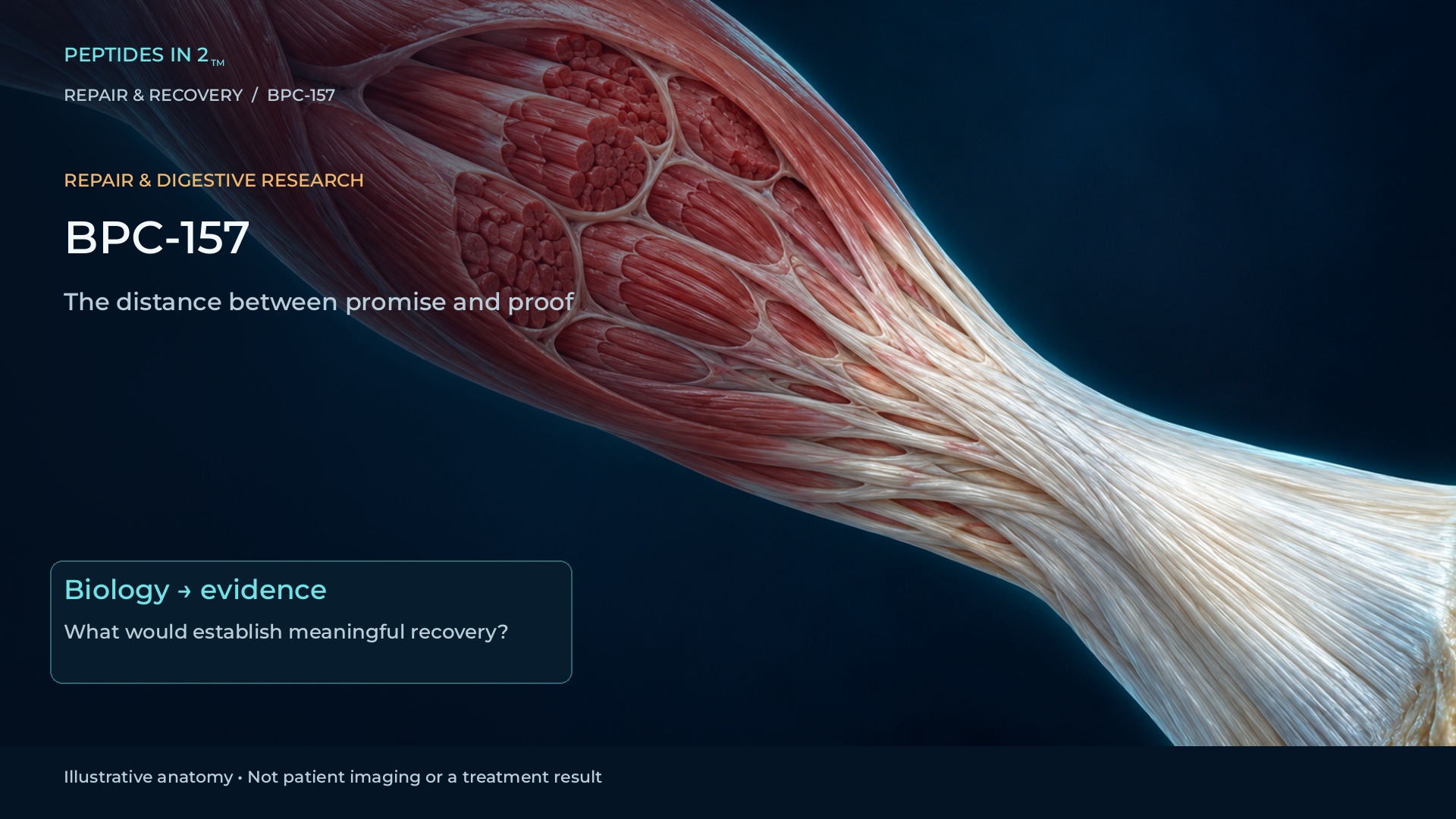
The film uses synthetic narration and original AI-generated conceptual anatomy. Its twelve content images each appear once. They are illustrative anatomy, not patient scans, verified histology, trial photographs, or demonstrated BPC-157 treatment effects. The shoulder and Achilles views provide general anatomy alongside a knee-pain report; they do not represent that study’s patients or findings. The established series title screen appears at the opening and closing.
No independent scientific peer review or complete manual caption review is claimed. References, prompts, timing, and rendering files are included in the source package. This is educational research context, without prescribing or administration instructions.
Read the English transcript
Repair begins with a biological response. Establishing that a treatment improves recovery takes a different kind of evidence.
BPC-157 is an experimental peptide made of fifteen amino acids. Laboratory and animal studies can suggest mechanisms. They cannot, by themselves, establish that an injured person will recover faster.
In a 2021 report, Lee and Padgett reviewed seventeen knee-pain patients and reached sixteen for follow-up. Twelve had received BPC-157 alone; eleven reported significant pain improvement. Four others received it with thymosin beta four.
Those reports came from an uncontrolled study. Less pain does not demonstrate that tendon or cartilage has healed.
The digestive tract is another major research focus. In rat experiments, BPC-157 reduced experimentally induced stomach ulcers and improved healing in some fistula models. These are encouraging animal findings.
Human evidence includes a 2005 ulcerative-colitis trial reported in a conference abstract. Fifty-three people were randomized. Disease-activity scores improved in both groups. The between-group estimate was too uncertain to establish a benefit over placebo.
The FDA concluded that the available data were inadequate to establish efficacy and safety for that use. Gastrointestinal promise is a research lead; reliable treatment success in people remains unproven.
The next step is a defined preparation, a fair comparison, and consistent measures of symptoms, function, and tissue change. Safety also needs adequate follow-up.
World Peptide Foundation. Peptides in 2. Every experience matters.
Download the episode materials
Next episode: Thymosin beta-4 & TB-500 →