Peptides in 2TM · CagriSema
Episode 11 · 2:00 · English
CagriSema: two peptides, complementary pathways
Cagrilintide and semaglutide remain two separate ingredients in one investigational combination. Follow the development story, complementary receptor pathways, REDEFINE 1 results, and the direct REDEFINE 4 comparison—keeping trial populations and estimates distinct.
English narration and optional captions. Caption timing is approximate. Translated subtitles are not yet available for this episode.
Published . Evidence cutoff: October 13, 2026.
Behind the film: CagriSema references & context
Peptides in 2 — Episode 11. Evidence cutoff: October 13, 2026. Educational information, not medical advice. WPF does not sell peptides. Source checking is distinct from independent scientific assessment or personal human review; neither is claimed. This two-minute introduction is selective, not complete prescribing guidance.
Identity and development
CagriSema combines cagrilintide and semaglutide as two separate active ingredients. It is not one peptide with two receptor targets. Novo Nordisk is the developer; clinical investigators and discovery researchers have different roles. Julio Frias and colleagues published a 32-week phase 2 study in 2023 involving 92 adults with type 2 diabetes. The publication date is not a date of invention. The trial was industry sponsored; employment and other conflicts are disclosed in the publication.
Source: Frias JP et al., The Lancet 402:720–730 (2023). PubMed 37364590. This was an active-controlled study, not a placebo comparison. The film does not present its weight-loss figures or turn an early study into proof of long-term safety.
Complementary receptor biology
Semaglutide activates GLP-1 receptors. Cagrilintide engages amylin and calcitonin receptors; amylin receptors contain a calcitonin receptor plus a receptor activity-modifying protein. Their contributions to appetite and fullness are complementary, not identical. A fixed combination is different from a unimolecular multi-receptor agonist such as tirzepatide or retatrutide.
Sources: Wegovy prescribing information, mechanism of action; experimental cagrilintide receptor paper, Nature Communications (2025). The animated nodes and paths are an original educational abstraction. They are not atomistic structures, receptor-binding trajectories or a literal route through a patient's body.
REDEFINE 1: keep the estimates distinct
The randomized study included 3,417 adults without type 2 diabetes, across all four groups, and lasted 68 weeks. Participants received the combination, semaglutide, cagrilintide or placebo, with lifestyle intervention. W. Timothy Garvey and the REDEFINE 1 Study Group are credited for the clinical publication, not as sole inventors of the combination.
The treatment-policy estimate was 20.4% mean weight reduction with CagriSema versus 3.0% with placebo. The separate adherence-assuming trial-product estimate was 22.7% with CagriSema. These analyses answer different questions and are not interchangeable. The averages do not predict an individual's response.
Source: Garvey WT et al., New England Journal of Medicine 393:635–647 (2025), DOI 10.1056/NEJMoa2502081. PubMed 40544433. Trial registration NCT05567796. Funded by Novo Nordisk; see the publication's conflict disclosures. Gastrointestinal events included nausea, vomiting, diarrhea and constipation. These are selected adverse events, not the entire safety profile.
Direct comparison: no blanket superiority claim
Novo's February 23, 2026 announcement reported that REDEFINE 4 did not meet its prespecified non-inferiority endpoint against tirzepatide. It was an 84-week open-label trial comparing the studied CagriSema combination with tirzepatide 15 mg. The treatment-regimen estimates were 20.2% and 23.6% weight loss, respectively. This finding belongs to that trial, population and comparison. It does not establish that every dose, indication or patient responds the same way.
Source: Novo Nordisk REDEFINE 4 company announcement. The film identifies it as company-reported evidence. Later comparisons used different populations and doses, including REIMAGINE 5; they must not be substituted for REDEFINE 4.
Current development and worldwide perspective
Novo's September 30, 2026 announcement still identifies CagriSema as investigational. REDEFINE addresses obesity; REIMAGINE addresses type 2 diabetes. Regulatory submissions or expected decisions are not approvals. The company reported submissions to the U.S. FDA and Health Canada in December 2025. The film makes no assertion of worldwide authorization, commercial supply, reimbursement or access. Its cutoff matters because status can change.
Sources: Novo Nordisk September 30, 2026 announcement; September 21, 2026 announcement, for separate trial contexts. Conference or company descriptions remain identified as such; the film does not present preliminary organ or brain-imaging findings as settled clinical benefit.
Photograph: investigator affiliation, not a trial room
UAB Blazer Hall, photograph by Lee Adlaf, via Wikimedia Commons, Creative Commons Attribution 2.0 Generic. Changes: 16:9 crop, resized image, dark readability shading, gentle camera movement and editorial overlays. No endorsement is implied. Retain the author, source, license link and changes when publishing.
This is a campus-context image of the University of Alabama at Birmingham, the institutional affiliation listed for first author W. Timothy Garvey in the REDEFINE 1 paper. Blazer Hall is not a clinical trial building, discovery laboratory or pharmaceutical manufacturing facility. The photograph neither documents an exact trial site nor credits the university as the inventor of CagriSema.
New artwork and production
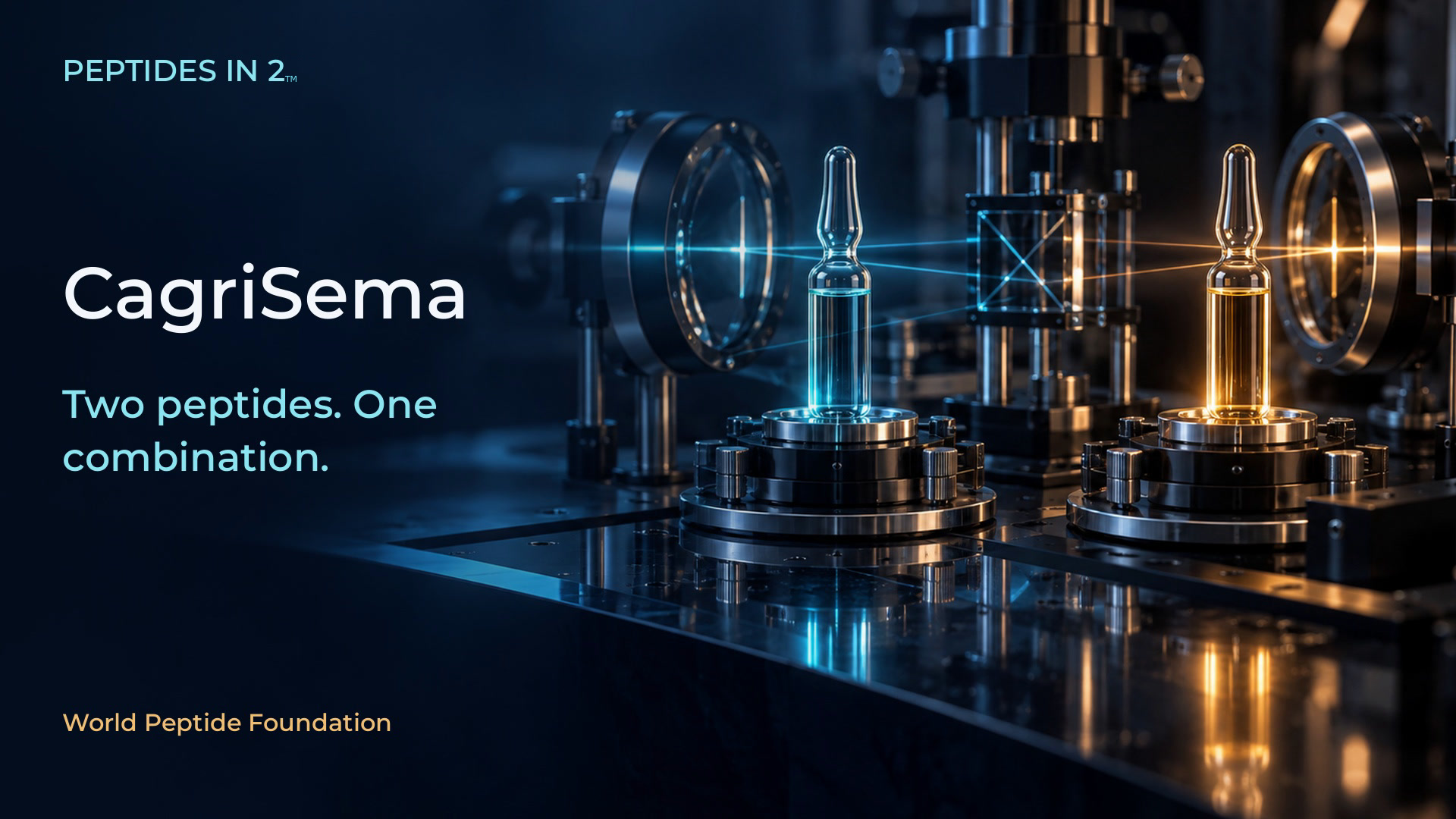
Six content images were newly created for this episode using built-in image generation: two research ampoules in an optical setting, capillary-analysis equipment, a membrane background, metabolic measurement equipment, ion-optics imagery and an imaging suite. They are conceptual educational artwork, not real photographs of Novo facilities, marketed CagriSema packaging, validated molecular structures, trial footage, patient data or authentic MRI scans. No content images from earlier episodes were reused.
Continuous camera movement and original pulsed pathway animation accompany the artwork. Cyan and amber distinguish the ingredients; the colors are editorial choices. The film does not claim that its ampoules depict the commercial formulation. The new clinical and instrument scenes supply research context, not visual proof of efficacy.
Established branding and the spoken WPF closing recur intentionally. The established Tom synthetic narrator is retained; no real scientist's voice is cloned. One new instrumental track is mixed quietly under speech, with a three-second opening build and final fade. The closing finishes before the fade: “Peptides in 2. World Peptide Foundation. Every experience matters.”
Montserrat is used under the SIL Open Font License, included in the source kit. Export: 1920×1080, 24 fps, 120 seconds, stereo AAC. English SRT and VTT captions are separate and optional; their timing is estimated within measured narration segments, not word-level forced alignment. The film uses conceptual artwork and synthetic narration as described here.
Corrections and useful primary sources: admin@worldpeptidefoundation.org. Scientific studies and self-reported observations remain distinct kinds of information.
Read the English transcript
Two peptides. Two complementary pathways. One combination. CagriSema brings cagrilintide and semaglutide together, without turning them into a single molecule.
Developed by Novo Nordisk in Denmark, its clinical story includes Julio Frias and colleagues' phase two study, published in twenty twenty-three. Ninety-two adults with type two diabetes were followed for thirty-two weeks.
Semaglutide activates GLP-one receptors. Cagrilintide engages amylin and calcitonin receptors. Their complementary signals influence appetite and fullness. Combining two medicines is different from engineering one peptide to activate several receptors.
The larger REDEFINE-one trial followed three thousand four hundred and seventeen adults without type two diabetes for sixty-eight weeks. Published in the New England Journal of Medicine in twenty twenty-five, it tested the combination, each component, and placebo.
Estimated average weight reduction was twenty point four percent with the combination, versus three percent with placebo, regardless of treatment adherence. A separate analysis assuming adherence gave twenty-two point seven percent. Those estimates answer different questions.
Nausea, vomiting, diarrhea and constipation were reported. And in twenty twenty-six, a direct comparison with tirzepatide did not meet its non-inferiority target. Greater complexity does not automatically mean better results.
As of October thirteen, twenty twenty-six, Novo still describes CagriSema as investigational. Research programmes address obesity and type two diabetes, with different populations and endpoints. Its promise rests on evidence, not the number of ingredients.
Peptides in 2. World Peptide Foundation.
Every experience matters.