Collection episode 01 · 2:05 · English
Peptides in 2TM · Thymosin alpha-1
Immune signals and clinical evidence
Follow thymosin alpha-1 from thymus biology and immune-cell communication into the corrected TESTS sepsis trial, with a clear distinction between a laboratory signal and a clinical benefit.
English narration with optional English captions. Caption timing is recognition-assisted. Translated subtitles are not yet available for this episode.
Published . Evidence checked: October 16, 2026.
Behind the film: references & context
Origins and molecular identity
Goldstein and colleagues reported the isolation and sequence of the 28-amino-acid peptide from calf thymus in 1977. A synthetic counterpart shares its amino acid sequence. A research reagent or compounded preparation should not be assumed equivalent to a studied finished product. [1][6]
Immune communication is a research question
Laboratory studies examine dendritic cells and T-cell responses. This biology connects innate and adaptive immune pathways, but a change in an immune marker does not automatically establish a clinical benefit. [2][3]
What the corrected TESTS trial found
TESTS randomized 1,106 adults at 22 centers in China. Among 1,089 participants in the modified intention-to-treat analysis, 28-day mortality was 127/542 (23.4%) with thymosin alpha-1 and 132/547 (24.1%) with placebo, alongside standard care. The May 2025 correction reports a hazard ratio of 0.97 (95% CI 0.76–1.24). This did not establish a mortality benefit; the interval includes possible benefit and harm. [4][5]
Keep the claim within the population studied
A treatment strategy studied in adults with sepsis does not demonstrate an immune-boosting benefit in healthy people or settle every question about thymosin alpha-1. Similar reported safety outcomes do not establish long-term safety. The FDA briefing reports no FDA-approved Ta1 drug products; regulatory status must remain separate from scientific effectiveness. [4][5][6]
Original sources and source access
- Goldstein et al. (1977) — Isolation and sequence of thymosin alpha-1
Original isolation and sequence report. PNAS 74:725–729; DOI 10.1073/pnas.74.2.725.
- Romani et al. (2004) — Dendritic cells and antifungal immune pathways
Experimental immune-pathway work, distinct from a clinical effectiveness claim. Blood 103:4232–4239.
- Yao et al. (2007) — Human monocyte-derived dendritic cells in vitro
Laboratory study of differentiation and function; an immune marker is not a clinical outcome.
- Wu et al. (2025) — TESTS randomized sepsis trial
BMJ 388:e082583; DOI 10.1136/bmj-2024-082583. Read with the published correction below.
- BMJ (May 2025) — Published TESTS correction
BMJ 389:r1098; DOI 10.1136/bmj.r1098. Corrected 28-day hazard ratio: 0.97 (95% CI 0.76–1.24). Supersedes the earlier estimate.
- FDA (2024) — Pharmacy Compounding Advisory Committee briefing
Printed page 21 / PDF page 25 reports no FDA-approved Ta1 drug products. Compounding review and orphan designation are distinct from marketing approval.
Production notes
Four original AI-generated images each appear once, with the established series artwork at the opening and closing. The complete synthetic narration is retained at normal speed, including its natural pauses. The graphic uses published trial counts and the corrected estimate. Prompts, timing, captions, narration, and rendering files are included in the source package.
Read the English transcript
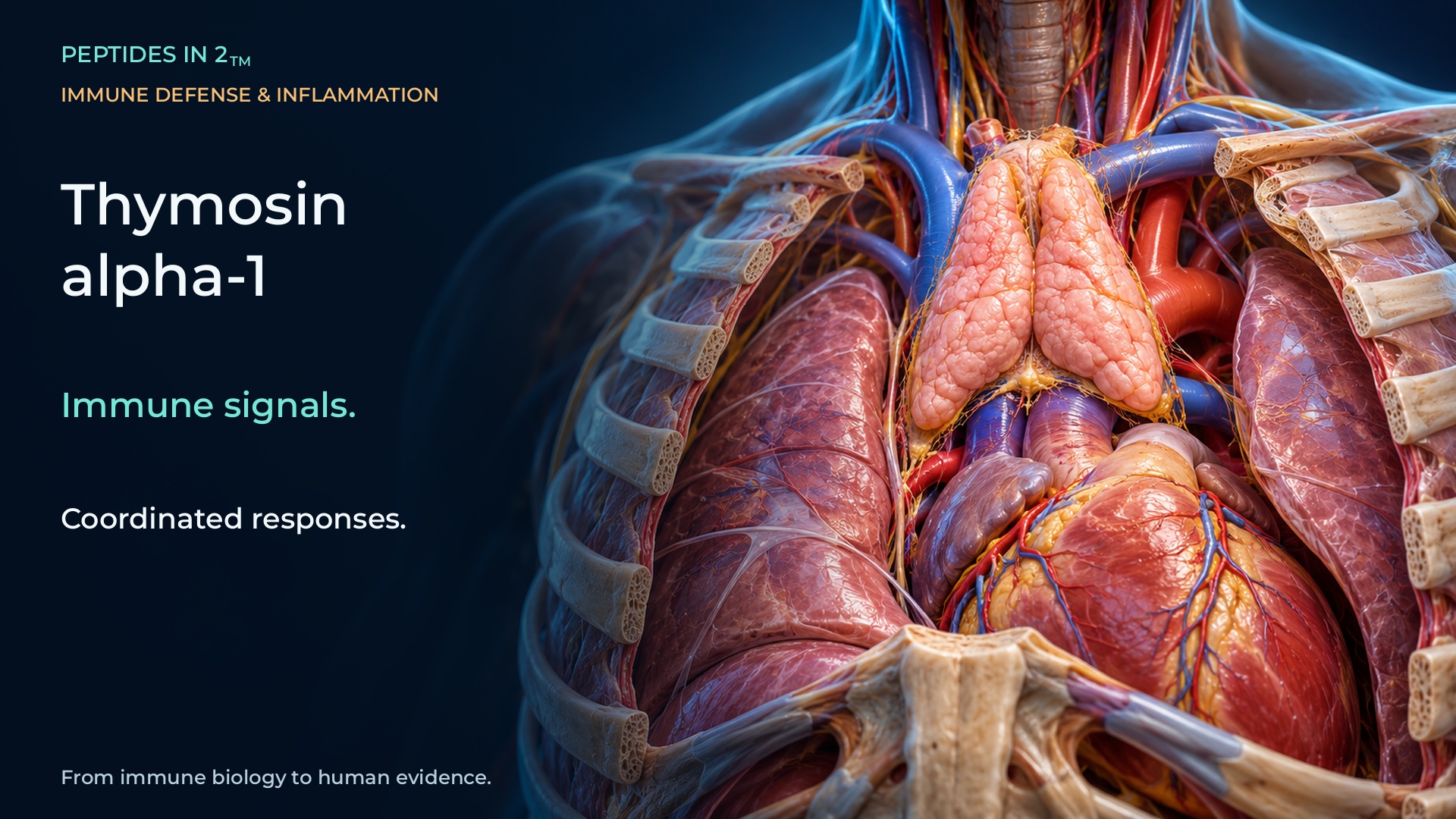
Thymosin alpha-1 opens our immune defense and inflammation collection. Immune health depends on coordinated responses.
In nineteen seventy-seven, Allan Goldstein and colleagues reported the isolation and sequence of this twenty-eight-amino-acid peptide from calf thymus. Its synthetic counterpart has the same amino acid sequence.
Laboratory studies examine how it influences dendritic cells, which help present information to T cells. This connects rapid innate defenses with targeted adaptive responses. Changes in an immune marker are not automatically clinical benefits.
That distinction matters in sepsis, where a dangerous response to infection can damage organs.
The TESTS trial enrolled eleven hundred six adults at twenty-two centers in China. Participants received thymosin alpha-1 or placebo alongside standard care.
Among the one thousand eighty-nine participants analyzed, twenty-eight-day mortality was twenty-three point four percent with the peptide and twenty-four point one percent with placebo. The corrected report found no clear mortality benefit. Its confidence interval included possible benefit and harm.
These findings describe a specific treatment strategy in adults with sepsis. They do not settle every question about thymosin alpha-1 or demonstrate an immune-boosting benefit in healthy people. Similar reported safety outcomes do not establish long-term safety. In the United States, it is not an FDA-approved medicine.
Connect immune biology to a defined disease, a measured outcome, and the strength of the human evidence.
World Peptide Foundation. Peptides in 2. Every experience matters.